Northern Chinese food: four landscapes, four questions
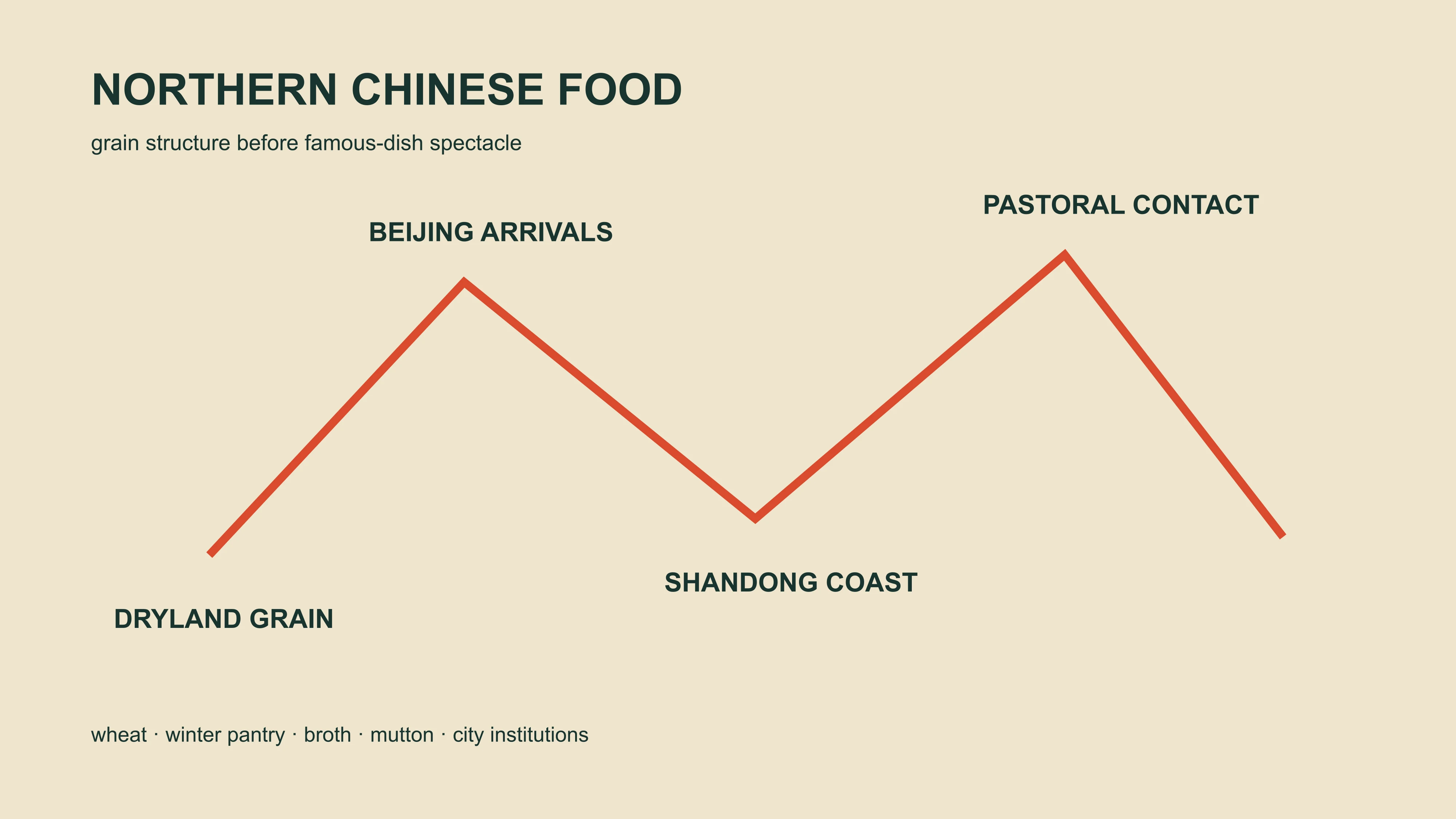
Use these routes as evidence checkpoints. None is a complete menu for the north, and each points to a different relationship among grain, water, livestock and urban demand.
| Place or route | What to notice | Boundary to keep |
|---|---|---|
| Beijing capital table | Roast duck, mutton hot pot, wheat sauces, palace memory and neighborhood snacks meet through migration into the capital. | Beijing food is not identical to imperial cuisine or to every dish eaten across northern China. |
| Shandong coast and plain | Clear and milky broths, scallion, vinegar, seafood and knife work reveal Lu cuisine's technical influence. | One restaurant's heavy seasoning does not define a province stretching from coast to inland plain. |
| North-China wheat belt | Noodles, buns, pancakes and dumplings turn hard and soft wheats into different textures and meal formats. | Wheat dominance does not mean rice, millet, maize, sorghum or tubers disappear. |
| Pastoral exchange | Mutton slicing, copper-pot boiling and dairy or grain contacts show movement across agrarian and pastoral zones. | Mutton hot pot does not make all northern food pastoral or all pastoral food Beijing food. |
The winter pantry explains more than the eight-cuisine chart
Low winter temperatures and a shorter growing season reward storage, drying, pickling and foods that can move from field to pantry without losing their usefulness. On the North China Plain, wheat is important, but millet, sorghum, maize, cabbage, radish, alliums and legumes also build the table. This ecology does not mechanically dictate a cuisine; markets, class and transport matter. It does explain why preserved vegetables, warming braises and dough skills became durable forms of everyday competence rather than picturesque traditions.
Wheat is a toolbox, not one northern staple
A northern cook can turn flour and water into hand-cut noodles, stretched noodles, knife-shaved ribbons, steamed mantou, filled baozi, crisp shaobing, soft pancakes or boiled jiaozi. Hydration, gluten development, rest, rolling and heat decide which food appears. The useful distinction is structural: a dumpling skin must seal and survive boiling; a noodle must extend or cut cleanly; a steamed bun must hold gas. Calling all of them 'doughy' misses the part that generations of cooks actually learned to control.
Beijing food is an archive of arrivals
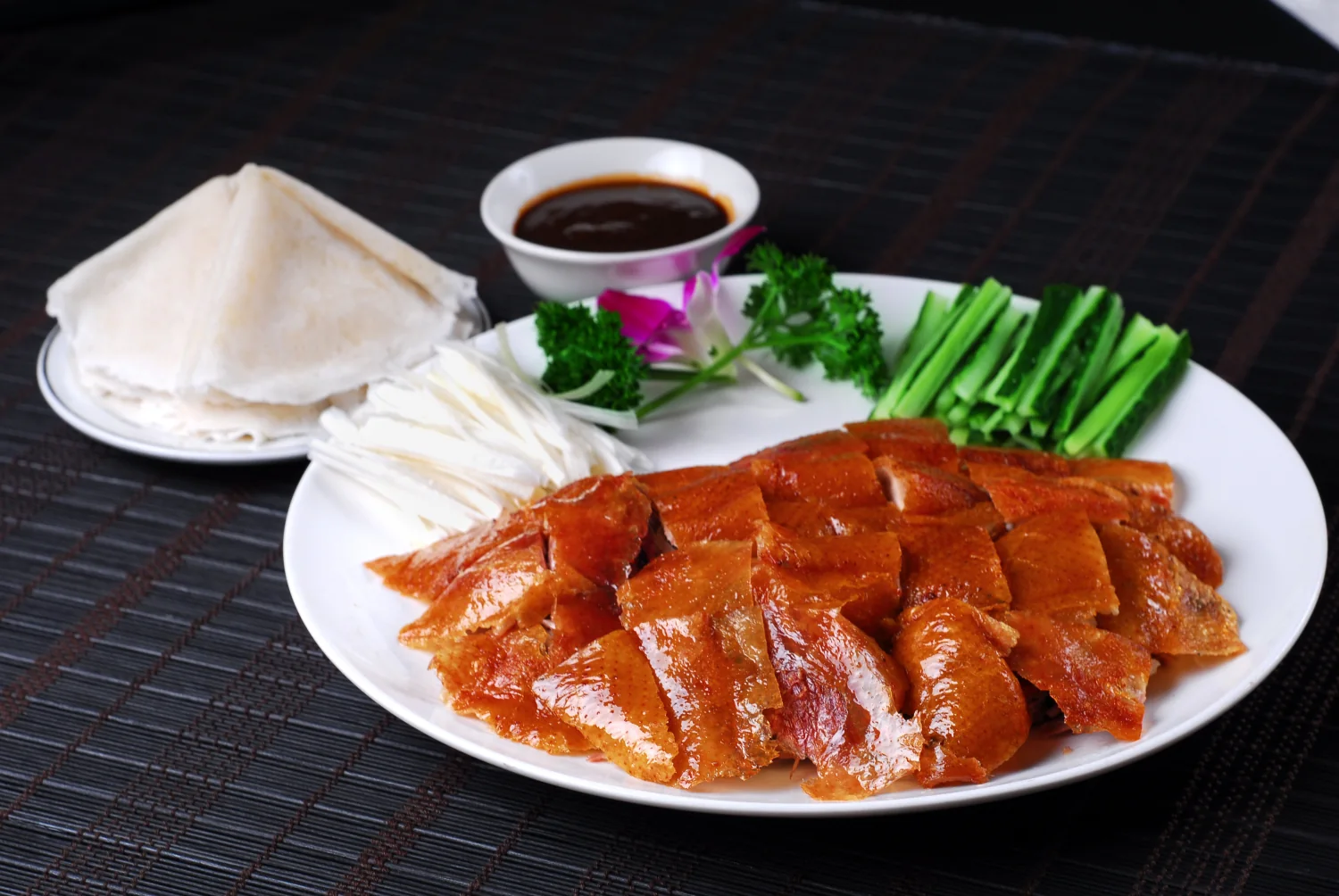
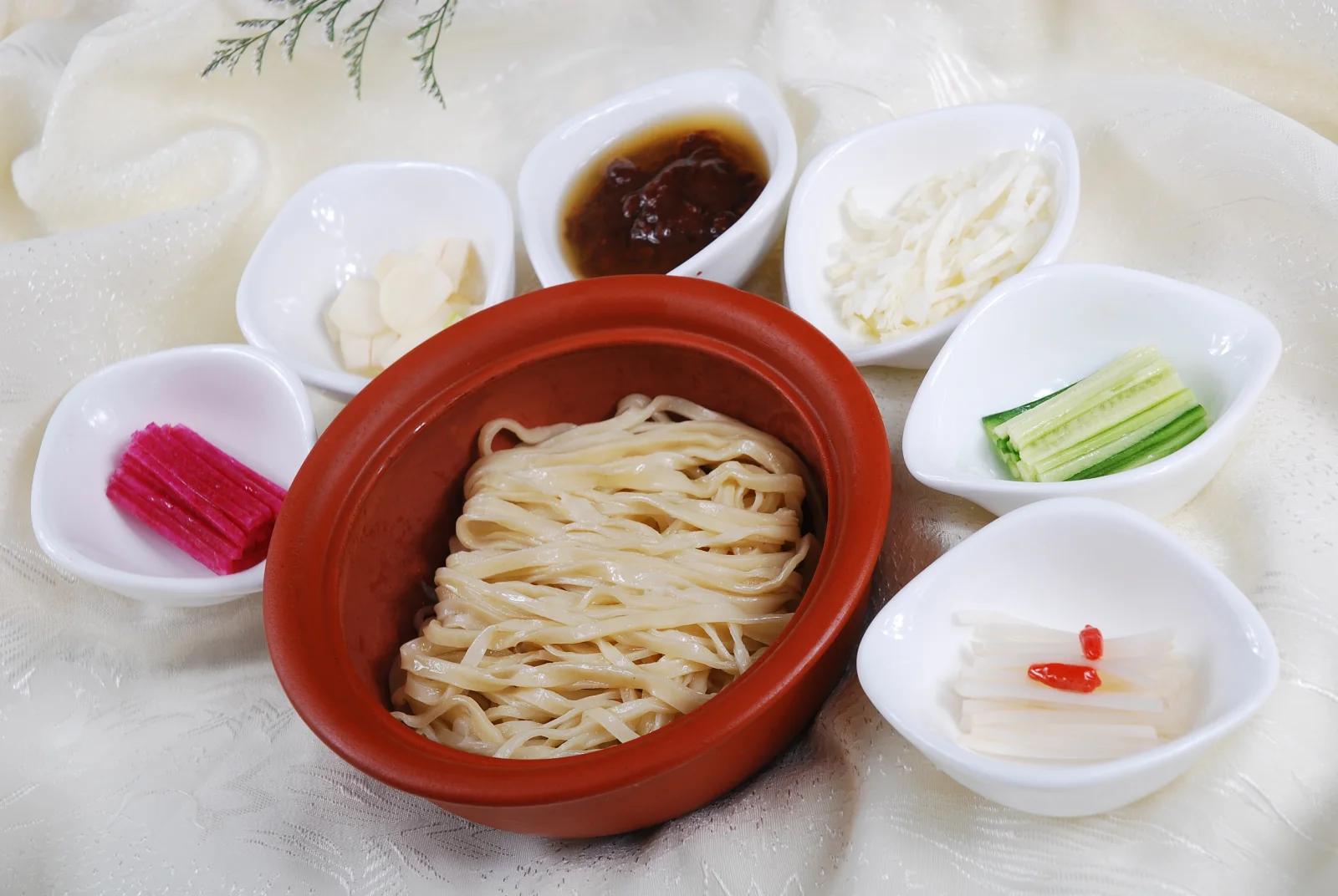
Beijing's table carries court kitchens, banner communities, Muslim restaurants, Shandong cooks, provincial offices, migrant labor and the demands of a modern megacity. The result is not a pure municipal cuisine. It is a layered urban archive in which roast duck can sit near fermented mung-bean drink, lamb hot pot, sesame bread and zhajiang noodles without becoming one coherent flavor profile. I like Beijing food most when it admits this crowded history; the capital's strength is selection and recombination, not the claim that every famous dish began inside its walls.
Broth, fire and the coast make Shandong more than Beijing's ancestor
Lu cuisine is often introduced as an influence on northern elite and restaurant cooking. That is true but incomplete. Shandong's long coast gives seafood a serious role, while inland plains support wheat and vegetables. Clear broth, milky emulsified broth, quick high-heat work and pronounced scallion or vinegar can all appear. The province contains Jinan, Jiaodong and Confucian-banquet traditions with different emphases. A plate of sweet-and-sour fish is therefore an entry point, never a license to compress coastal freshness, banquet discipline and home food into one canonical Shandong taste.
Mutton maps contact between field, city and pasture
Mutton in northern cooking cannot be explained as a simple climate preference. Herding economies, Muslim communities, Mongolian and Manchu histories, military supply, market routes and urban restaurant demand all participate. Beijing's thin-sliced mutton hot pot values clean meat, quick cooking and sesame-based dipping sauce; cumin-heavy skewers point toward other routes and communities. Keeping those formats separate prevents a familiar mistake: treating every lamb dish as Silk Road food. The animal travels, but the cut, vessel, seasoning and people serving it determine the foodway.
Northern flavor often comes from surfaces
Rolling a pancake thin, blistering a flatbread, browning the base of a dumpling, crisping duck skin and frying a sauce until its raw edge disappears all create flavor at the surface. This is why a list of soy sauce, vinegar and garlic never explains the cuisine. The pan, griddle, oven, steamer and boiling pot produce different crusts and moisture gradients. When ordering, compare two wheat foods before chasing ten famous names: one boiled, one baked or griddled. The contrast will teach more about northern technique than a banquet of unrelated signatures.
Tianjin, Jinan, Beijing and Kaifeng should not share one caption
Tianjin's port and commercial snack culture, Jinan's inland Shandong cooking, Beijing's capital institutions and Kaifeng's long urban and Muslim histories produce different restaurant ecosystems. Even when baozi, noodles or lamb recur, their dough, broth, portion and social role change. A traveler should ask which city a dish is being used to represent and why. 'Northern style' on an overseas menu may be a useful sales category, but it is weak evidence. The city name, maker's background and exact technique are stronger clues than the compass direction alone.
Order one dough, one vegetable and one broth
My preferred first meal is deliberately unglamorous: a wheat staple that exposes dough skill, a seasonal or preserved vegetable that shows pantry logic, and a broth or braise that reveals extraction and seasoning. Add a famous meat dish only after those foundations. This order protects the reader from judging the north by roast duck theater or a dumpling sampler designed for tourists. Good northern food should make cabbage, radish, egg, tofu and grain feel chosen, not apologetic. If every plate depends on sugar, oil and meat, the kitchen is hiding its range.
Northern does not mean bland, heavy or culturally uniform
Garlic heat, mustard sharpness, mature vinegar, fermented bean sauces, scallion fragrance and chili all complicate the stereotype of mild beige food. At the same time, intensity is not one regional setting. A mustard-laced cold dish and a chile-heavy Shaanxi noodle make different arguments. The category also contains Han, Hui, Manchu, Mongolian and many other histories that cannot be dissolved into climate. Geography gives us a useful first map; community, labor and technique keep that map honest. Any guide that stops at 'cold weather means hearty food' has stopped before the human story begins.
Come back with the staple's exact name
Northern restaurant menus change quickly outside China, and English labels often erase the key verb: pulled, shaved, rolled, steamed, griddled or boiled. Save the Chinese name or photograph the menu, then return to compare how another city handles the same grain. East Moment will keep expanding this page around dough structure, winter pantry evidence and city-specific tables rather than adding an endless list of dishes. The return value is comparison: one baozi or bowl means little until a second version makes the maker's choices visible.